Interest rate benchmarks
Know the key reference rates used globally, their construction, conventions, and the mechanics of compounding overnight rates over a period.
1. What is an interest rate benchmark?
An interest rate benchmark is a published reference rate that represents the cost of borrowing money for a given currency and tenor. It serves as a single source of truth: a standardised, independently calculated number that any market participant can observe and reference at the same time. Without benchmarks, every loan, bond, or derivative contract would need to negotiate its own definition of “the prevailing interest rate”, leading to disputes, opacity, and fragmented markets. Benchmarks solve this by providing a common anchor. When a floating-rate loan resets at “3-month EURIBOR + 1.20%”, both the borrower and the lender know exactly which number to look up, where it is published, and how it was calculated. The benchmark eliminates ambiguity and makes contracts comparable across counterparties, institutions, and borders.
2. The LIBOR era
2.1 What LIBOR was
For four decades, the dominant global benchmark was the London Interbank Offered Rate (LIBOR). First published in 1986 by the British Bankers’ Association (BBA), LIBOR was designed to measure the rate at which banks in London could borrow unsecured funds from each other in the interbank market.
Each business day, a panel of major banks submitted a rate for each of several currencies and tenors. The administrator removed the highest and lowest submissions and averaged the remainder. The result was published by mid-morning London time. LIBOR covered five currencies (US Dollar, British Pound, Euro, Swiss Franc, and Japanese Yen) and seven tenors (overnight, one week, one, two, three, six, and twelve months).
At its peak, an estimated USD 350 trillion of financial contracts referenced LIBOR. These included syndicated loans, floating rate notes, mortgages, interest rate swaps, and a wide range of structured products. For a generation of practitioners, LIBOR was simply the interest rate.
2.2 How LIBOR was used in practice
A European company borrows EUR 50 million on a five-year floating rate loan. The loan agreement states that interest resets every three months at three-month EURIBOR plus 1.00%. On each reset date, the bank looks up the published three-month EURIBOR fixing, adds 1.00%, and calculates the interest payment due for the coming quarter. The company’s interest cost moves with the market, but its credit spread (the 1.00%) remains fixed.
The same mechanism applied across currencies. A US company borrowing in dollars referenced three-month US Dollar LIBOR. A Japanese borrower referenced JPY LIBOR. The underlying logic was identical regardless of currency.
3. The LIBOR scandal
3.1 The flaw in the design
LIBOR’s methodology contained a structural weakness that was not widely appreciated until it became a crisis.
The rate was based on submissions, not transactions. Banks were asked where they could borrow, not where they actually borrowed. In a liquid market with many active participants, this distinction matters little: competitive pressure keeps submissions honest. But in a thin or dysfunctional market, submissions become a matter of judgement and are open to influence.
Two separate forms of manipulation emerged.
The first was crisis-era lowballing. During the 2008 financial crisis, banks were reluctant to submit accurate funding rates because doing so signalled their own distress to the market. A bank that submitted a high rate implicitly admitted it was struggling to raise funds. To protect their reputations, several banks systematically submitted rates below their true funding costs. This understated the stress in the interbank market during a period when accurate information was most important.
The second was trader-driven manipulation. Traders at several banks, sometimes acting in coordination with traders at other institutions, requested that their bank’s submitters nudge LIBOR fixings in directions that benefited their own trading positions. Even a movement of one or two basis points in a daily fixing could generate significant profits on a large derivatives book. Internal communications later made public showed traders openly discussing desired fixing levels as favours between colleagues.
3.2 Investigations and consequences
Regulators in the United States, the United Kingdom, Europe, and Japan launched coordinated investigations beginning around 2011 and 2012. The findings were damaging.
Between 2012 and 2015, major banks including Barclays, UBS, Royal Bank of Scotland, Rabobank, and Deutsche Bank reached settlements with regulators totalling several billion dollars. On 27 June 2012, Barclays became the first bank to settle, paying USD 450 million to US and UK authorities. Individual traders and submitters in multiple jurisdictions faced criminal prosecution. Tom Hayes, a former UBS and Citigroup trader, was convicted in the United Kingdom in 2015 and sentenced to fourteen years in prison, later reduced on appeal.
The reputational damage extended beyond the fines. The scandal demonstrated that LIBOR, the foundation of global fixed income markets, had been manipulated for years. Regulators concluded that a rate based on expert judgement rather than actual transactions could not be trusted as a long-term foundation for financial markets.
3.3 Reform and replacement
Following the publication of the Wheatley Review in September 2012, the UK government transferred responsibility for LIBOR administration from the BBA to the Intercontinental Exchange (ICE), which continues to administer the remaining LIBOR rates as ICE LIBOR. Governance and submission processes were tightened substantially.
The Financial Conduct Authority (FCA) in the United Kingdom announced in July 2017 that it would no longer compel panel banks to submit to LIBOR after the end of 2021. This announcement set a firm end-date for the benchmark and triggered a global effort to develop and adopt replacement rates.
Most LIBOR settings ceased after 31 December 2021. The most widely used USD LIBOR settings continued on a synthetic basis until 30 June 2023, giving USD markets additional transition time given the enormous volume of legacy contracts referencing those rates.
4. The new benchmark landscape
The LIBOR transition produced a new generation of benchmarks across major currencies. These new rates share a common design principle: they are grounded in actual transactions rather than bank submissions.
4.1 Overnight risk-free rates
The first category of replacement benchmarks are overnight risk-free rates (RFRs). These rates measure the cost of borrowing overnight on a secured or unsecured basis, using observed market transactions. They are published daily and are considered more robust than submission-based rates because manipulation requires moving actual market transactions, not just submissions.
The major overnight RFRs are:
- SOFR (Secured Overnight Financing Rate): the US Dollar benchmark, published by the New York Federal Reserve since April 2018. SOFR is secured, meaning it measures overnight borrowing collateralised by US Treasury securities. It replaced USD LIBOR as the primary USD benchmark.
- €STR (Euro Short-Term Rate): the euro benchmark, published by the European Central Bank (ECB) since October 2019. €STR measures the cost of unsecured overnight borrowing in euros between euro area banks and other financial counterparties.
- SONIA (Sterling Overnight Index Average): the sterling benchmark, administered by the Bank of England. SONIA has existed since 1997 but was reformed and strengthened in 2018 as part of the transition away from GBP LIBOR.
- TONA (Tokyo Overnight Average Rate): the Japanese yen benchmark, administered by the Bank of Japan.
- SARON (Swiss Average Rate Overnight): the Swiss franc benchmark, administered by SIX Financial Information.
4.2 SOFR in detail
SOFR measures the rate on overnight repurchase agreements (repos) collateralised by US Treasury securities. The New York Fed calculates it daily from a large volume of actual transactions, typically exceeding USD 1 trillion per day, making it one of the most transaction-rich benchmarks in existence.
Because SOFR is secured (backed by collateral), it generally trades slightly below unsecured rates in normal market conditions. This was a point of debate during the LIBOR transition: LIBOR included a credit premium reflecting the risk that a bank might fail before repaying its overnight loan, and SOFR does not. Instruments that previously referenced LIBOR therefore needed adjustment to reflect this difference when transitioning to SOFR.
4.3 €STR in detail
€STR reflects the cost of unsecured overnight borrowing in euros by euro area banks from other financial institutions, including other banks, money market funds, insurance companies, and pension funds. The ECB computes it daily from actual transaction data collected from reporting banks under the Money Market Statistical Reporting (MMSR) framework.
€STR replaced EONIA (Euro Overnight Index Average), an older overnight benchmark that was found to be non-compliant with the EU Benchmarks Regulation (BMR) because it was based on panel bank submissions rather than transactions. EONIA was discontinued on 3 January 2022.
For instruments that previously referenced EONIA, the transition to €STR was straightforward: €STR plus a fixed spread of 8.5 basis points was established as the EONIA replacement, reflecting the historical average difference between the two rates.
4.4 EURIBOR and its reform
Unlike LIBOR, EURIBOR survived the reform era and continues to serve as the primary term benchmark for the euro. EURIBOR is administered by the European Money Markets Institute (EMMI) and reflects the rate at which banks in the European Union can borrow in the interbank market for tenors from one week to twelve months.
Following the LIBOR scandal, EMMI overhauled EURIBOR’s methodology to make it compliant with the EU Benchmarks Regulation. The reformed EURIBOR uses a waterfall methodology:
- Where sufficient actual transactions exist, the rate is based on transactions (Level 1).
- Where transactions are insufficient, the rate is supplemented with related market data such as other maturities or closely related markets (Level 2).
- Where neither is available, the rate falls back on expert judgement by the panel bank (Level 3).
The reformed methodology was adopted in 2019 and EURIBOR received authorisation under the EU Benchmarks Regulation. It remains the dominant benchmark for euro-denominated floating rate loans, bonds, and interest rate swaps in Europe.
EURIBOR currently exists at five tenors: one week, one month, three months, six months, and twelve months.
4.5 Forward-looking term rates vs. overnight RFRs
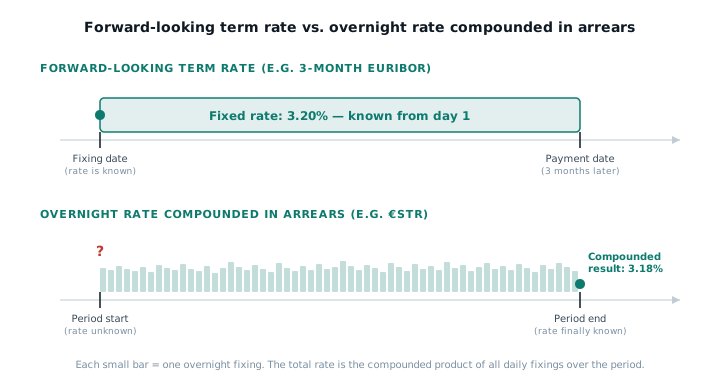
A forward-looking term rate such as EURIBOR fixes once at the start of the interest period for a defined tenor (e.g. three months). A borrower paying 3-month EURIBOR + 1.00% knows on day one exactly how much interest is due at the end of the quarter. This makes cash flow planning straightforward.
An overnight RFR such as €STR or SOFR, by contrast, publishes a new rate every business day. To produce an interest amount for a full quarter, the overnight rate must be compounded daily over the period. The total is only known at the end. This is economically clean as it reflects actual overnight borrowing costs day by day, but it means the borrower cannot calculate the payment in advance.
The diagram below illustrates the difference.
In euro markets, this distinction is less of a practical problem because EURIBOR, a forward-looking term rate, remains the dominant benchmark for loans and bonds. Borrowers continue to receive their rate at the start of each period.
In USD and GBP markets, where LIBOR has been replaced by overnight RFRs (SOFR and SONIA), the industry has developed term rate alternatives to restore that convenience. Term SOFR, produced by CME Group, provides forward-looking 1-month, 3-month, and 6-month rates derived from SOFR derivatives markets. It fixes at the start of the period, just like LIBOR used to. EMMI publishes a similar €STR-based term rate for euro markets, though its adoption remains limited given the continued availability of EURIBOR.
Term rates have been widely adopted in the loan market because they preserve the operational simplicity of knowing the interest payment upfront. In the derivatives market, however, compounded in arrears remains the standard, as it more accurately reflects the actual overnight funding cost over the period.
5. Market conventions by benchmark
Each benchmark rate comes with a set of conventions that determine exactly how it is applied in a financial contract. Knowing these conventions is essential: a mismatch between a loan and its hedge, even something as minor as a different day count or fixing lag, can create unexpected cash flow differences.
5.1 EURIBOR
| Convention | Detail |
|---|---|
| Administrator | European Money Markets Institute (EMMI) |
| Currency | EUR |
| Type | Unsecured term rate |
| Available tenors | 1 week, 1 month, 3 months, 6 months, 12 months |
| Day count | ACT/360 |
| Fixing time | 11:00 CET (Brussels time) |
| Fixing lag | T+2 (the rate fixes two business days before the start of the interest period) |
| Business day convention | Modified Following |
| Calendar | TARGET |
| Publication | Daily, on TARGET business days |
EURIBOR is a forward-looking term rate: the rate for the coming period is known at the start. This makes it operationally convenient for loans and bonds, as the borrower can calculate the interest payment in advance.
5.2 €STR
| Convention | Detail |
|---|---|
| Administrator | European Central Bank (ECB) |
| Currency | EUR |
| Type | Unsecured overnight rate |
| Tenor | Overnight |
| Day count | ACT/360 |
| Fixing time | 08:00 CET (published the morning after the trading day) |
| Fixing lag | T+1 (reflects transactions from the previous business day) |
| Business day convention | Modified Following (when used in derivatives) |
| Calendar | TARGET |
| Publication | Daily, on TARGET business days |
Because €STR is an overnight rate, it must be compounded daily over the interest period to produce a term-equivalent rate. The total interest is only known at the end of the period (compounded in arrears). A common variant applies a lookback or payment delay of a few business days to give counterparties time to calculate and settle the payment.
5.3 SOFR
| Convention | Detail |
|---|---|
| Administrator | Federal Reserve Bank of New York |
| Currency | USD |
| Type | Secured overnight rate (based on Treasury repo transactions) |
| Tenor | Overnight |
| Day count | ACT/360 |
| Fixing time | 08:00 ET (published the morning after the trading day) |
| Fixing lag | T+1 (reflects transactions from the previous business day) |
| Business day convention | Modified Following (when used in derivatives) |
| Calendar | New York / US Government Securities |
| Publication | Daily, on US business days |
Like €STR, SOFR is compounded in arrears for most derivative and loan applications. Term SOFR (published by CME Group) provides forward-looking 1-month, 3-month, and 6-month rates for use in loans where advance knowledge of the payment is required.
5.4 SONIA
| Convention | Detail |
|---|---|
| Administrator | Bank of England |
| Currency | GBP |
| Type | Unsecured overnight rate |
| Tenor | Overnight |
| Day count | ACT/365 |
| Fixing time | 09:00 London time (published the morning after the trading day) |
| Fixing lag | T+1 (reflects transactions from the previous business day) |
| Business day convention | Modified Following (when used in derivatives) |
| Calendar | London |
| Publication | Daily, on London business days |
Note that SONIA uses ACT/365, in line with the sterling money market convention, while SOFR and €STR use ACT/360. This is a common source of confusion when comparing rates across currencies: a quoted rate of 4.00% on an ACT/365 basis is not identical to 4.00% on an ACT/360 basis in terms of the actual cash flow produced.
6. Why this matters for treasury practitioners
Interest rate benchmarks appear throughout corporate treasury in three ways.
Borrowing costs. Floating rate credit facilities typically reference a benchmark plus a margin. The benchmark resets periodically, and the company’s interest expense moves accordingly. Understanding which benchmark applies, and how it is calculated, is essential for cash flow forecasting and budget planning.
Derivatives. Interest rate swaps, the primary tool for converting floating rate debt to fixed, reference the same benchmark as the underlying loan. A company that borrows at three-month EURIBOR and wants fixed cost certainty would enter an interest rate swap in which it pays a fixed rate and receives three-month EURIBOR from the bank. The benchmark ties the loan and the hedge together. Chapters covering interest rate swaps build on the definitions established here.
Investment. Money market funds, floating rate notes, and short-term bank deposits often pay returns linked to overnight benchmarks. A corporate treasury investing surplus cash needs to understand what rate the investment references and how it compares to the company’s cost of funds.
7. Swap rate benchmarks: ISDA fixings and their uses
7.1 What is a swap rate benchmark?
The benchmarks discussed so far (EURIBOR, €STR, SOFR, SONIA) measure short-term borrowing costs: either overnight or for a few months. But many financial products need a reference rate that captures the cost of borrowing (or the price of a fixed-rate commitment) over longer horizons: 5 years, 10 years, or even 30 years. This is where swap rate benchmarks come in.
A swap rate benchmark is a published rate that represents the fixed rate on a standard interest rate swap for a given currency and maturity. In a plain vanilla interest rate swap, one party pays a fixed rate and the other pays a floating rate. The swap rate is the fixed rate at which the two sides have equal value at inception, in other words, the “fair” fixed rate for that maturity. Swap rates exist for a range of maturities and provide a term structure of interest rates that extends well beyond what short-term benchmarks cover.
7.2 ISDA fixings (ICE Swap Rate)
The most widely referenced swap rate benchmarks are the ISDA fixings, now formally known as ICE Swap Rate, administered by ICE Benchmark Administration (IBA). These are published daily for major currencies including EUR, USD, and GBP, across standard maturities from 1 year to 30 years.
The ICE Swap Rate is calculated from executable bid and offer prices provided by swap dealers at a specific time each day. For EUR, the snapshot is taken at 11:00 CET. The methodology uses actual tradeable quotes rather than submissions, making it more robust than the old ISDAFIX benchmark it replaced.
| Convention | Detail |
|---|---|
| Administrator | ICE Benchmark Administration (IBA) |
| Former name | ISDAFIX |
| Currencies | EUR, USD, GBP (and others) |
| Maturities | 1Y to 30Y (standard tenors) |
| EUR fixing time | 11:00 CET |
| USD fixing time | 11:00 New York time |
| Basis | Executable swap quotes from dealers |
| Publication | Daily, on relevant business days |
7.3 Where swap rate benchmarks are used
Swap rate benchmarks serve as the reference rate for two important categories of financial products.
CMS-linked products. A Constant Maturity Swap (CMS) rate is simply the swap rate for a specific maturity observed at regular intervals. For example, the “10-year EUR CMS rate” is the 10-year EUR swap rate as published on each fixing date. Products that pay a coupon linked to a CMS rate are called CMS-linked instruments. A typical example is a floating-rate note that pays the 10-year EUR CMS rate minus a fixed spread every quarter. Unlike a standard floating-rate note linked to 3-month EURIBOR (which tracks short-term rates), a CMS-linked note gives the investor exposure to long-term rates. These products are used by investors who want to express a view on the level or direction of long-term swap rates, or by issuers looking to diversify their funding structure. The ISDA fixing provides the objective, published reference that both parties use to determine the coupon.
Cash-settled swaptions. A swaption is an option to enter into an interest rate swap at a pre-agreed fixed rate (the strike) on a future date. When a swaption is cash-settled rather than physically settled, the parties do not actually enter into the swap at expiry. Instead, the swaption’s value is calculated based on the difference between the strike rate and the prevailing swap rate at expiry, and one party pays the other a cash amount. The ISDA fixing at the expiry time is the standard reference used to determine that prevailing swap rate. This ensures both parties agree on a single, independently published number, avoiding disputes about what the “market rate” was at the moment of expiry.
7.4 Why this matters
For most corporate treasury teams, swap rate benchmarks are less directly visible than EURIBOR or SOFR as they rarely appear in loan agreements. But they are present in the background whenever a company enters a swaption, purchases a structured product with a long-term rate reference, or encounters a CMS-linked coupon in an investment portfolio. Understanding that these rates exist, how they are fixed, and what they represent helps when evaluating term sheets or discussing hedging strategies with a bank.
8. Key takeaways
- An interest rate benchmark is a published reference rate used to price floating rate instruments and to value derivatives. It must be calculated independently and consistently to be credible.
- LIBOR dominated global markets for four decades but was found to have been systematically manipulated. Most LIBOR settings were discontinued after 31 December 2021.
- The replacement benchmarks, known as risk-free rates, are grounded in actual market transactions. The major examples are SOFR (US Dollar), €STR (Euro), and SONIA (Sterling).
- EURIBOR was reformed rather than replaced. It uses a waterfall methodology anchored in actual transactions and remains the primary term benchmark for euro-denominated instruments.
- The difference between overnight rates and term rates matters operationally: overnight rates require compounding in arrears or the use of a separately published term rate to give borrowers certainty at the start of an interest period.
- The EU Benchmarks Regulation and its UK equivalent now govern how benchmarks are produced and used, with the goal of preventing a repeat of the LIBOR scandal.
Further reading
European Central Bank — €STR
The ECB publishes daily €STR fixings along with methodology documentation and historical data. The methodology section explains the MMSR data collection framework in detail.
ecb.europa.eu/stats/financial_markets_and_interest_rates/euro_short-term_rate
New York Federal Reserve — SOFR
The New York Fed publishes SOFR daily along with the underlying repo transaction data. It also publishes compounded SOFR averages at 30, 90, and 180 day horizons for use in floating rate instruments.
newyorkfed.org/markets/reference-rates/sofr
EMMI — EURIBOR
The European Money Markets Institute publishes daily EURIBOR fixings and the full methodology documentation for the reformed waterfall approach.
emmi-benchmarks.eu/euribor-org/euribor-rates
Marc Henrard — Interest Rate Instruments and Market Conventions Guide, Post-LIBOR edition (2025)
The most thorough and up-to-date public reference on market conventions for IR instruments. Covers day count conventions, schedule generation, compounding methods for overnight rates, and the transition from LIBOR in detail. Freely available on SSRN.