Interest rate swaps explained
Understand what defines the product, its working principle and how it is used to hedge interest rate risk. Without any pricing math.
1. A typical problem an interest rate swap solves
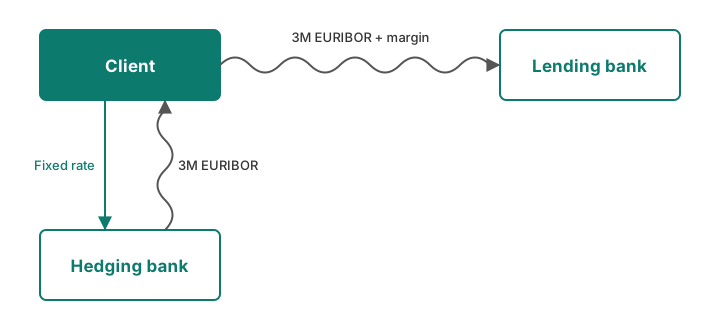
A company borrows EUR 100 million for five years on a floating rate basis, paying three-month EURIBOR plus a margin every quarter. The interest cost moves with short-term rates. If EURIBOR averages 2% over the life of the loan, the company pays one amount. If it averages 5%, the cost is materially higher. The company has the loan it needs, but the future interest expense is uncertain.
The treasurer wants to completely remove that uncertainty: the standard solution is an interest rate swap (IRS). The company enters a separate derivative contract in which it agrees to pay a fixed rate to a bank and receive a floating rate from that bank, on the same notional amount and the same dates as the loan. The floating leg of the swap offsets the floating leg of the loan. What remains is a fixed cost.
2. The structure of a plain vanilla swap
A plain vanilla interest rate swap is an agreement between two parties to exchange two streams of interest payments on a single notional amount, in a single currency, over a defined period.
One party pays interest at a fixed rate agreed at inception. The other pays interest at a floating rate that resets periodically against a published benchmark. The benchmark conventions are the same as those described in the chapter Interest rate benchmarks: typically EURIBOR or compounded €STR for euro swaps, compounded SOFR for US dollar swaps.
The notional itself is never exchanged. It exists only to calculate the size of each interest payment. This is the most important structural difference between a swap and a loan: a loan moves principal, a swap does not.
3. Payer and receiver: two sides of the same trade
By convention, the two sides of an interest rate swap are named after what they do with the fixed leg.
A payer swap (also called a pay-fixed swap) is one in which the party in question pays the fixed rate and receives the floating rate. Entering a payer swap is economically equivalent to borrowing at fixed and lending at floating. It benefits when rates rise, because the floating rate received increases while the fixed rate paid stays constant.
A receiver swap (also called a pay-float swap) is the mirror image. The party receives the fixed rate and pays the floating rate. It is equivalent to borrowing at floating and lending at fixed. It benefits when rates fall.
| Position | Pays | Receives | Benefits when rates |
|---|---|---|---|
| Payer (pay-fixed) | Fixed | Floating | Rise |
| Receiver (pay-float) | Floating | Fixed | Fall |
A corporate with floating-rate debt who wants to lock in cost certainty enters a payer swap. The fixed payments to the bank, combined with the floating receipts from the bank, leave the company effectively paying a fixed rate on its underlying debt.
A bank with a consequent portfolio of floating-rate mortgages faces the opposite risk: if short-term rates fall, the interest received on the mortgages drops with each reset. The bank can enter a receiver swap with a duration that matches the mortgage portfolio. The fixed rate received from the swap supplements the lower mortgage income, while the floating rate paid on the swap moves down with the mortgage receipts. The net interest income is stabilised.
4. Conventions: the legs in detail
4.1 Fixed leg
The fixed leg pays a constant interest rate for the life of the swap. Its conventions specify exactly how each payment is computed.
- Frequency: how often the fixed leg pays. The standard for EUR interbank swaps is annual. For USD swaps it is typically semi-annual.
- Day count convention: how each year fraction is calculated. The standard for the EUR interbank fixed leg is 30/360. SOFR-based USD swaps use ACT/360.
- Business day convention: how a payment date that falls on a non-business day is moved. Modified Following is the market standard.
- Calendar: which holidays apply. TARGET for EUR, US Government Securities for USD.
4.2 Floating leg
The floating leg pays an interest amount based on a benchmark rate observed during each period. Its conventions are richer than the fixed leg’s because they describe both how the rate is observed and how it is paid.
- Benchmark: the reference rate. EURIBOR for IBOR-style EUR swaps, compounded €STR for OIS-style EUR swaps, compounded SOFR for USD swaps.
- Reset frequency: how often the rate is observed. For a 3M EURIBOR leg this is quarterly. For an OIS leg the rate is observed daily and compounded over the period.
- Payment frequency: how often interest is paid. Often the same as the reset frequency, but not always.
- Compounding: how multiple observations within a period are combined into a single rate. Daily compounding applies for OIS-style legs.
- Payment delay: for compounded overnight legs, a few business days are typically added between the end of the observation period and the payment date, to give time for the final rate to be calculated.
- Spread: an optional fixed margin added to or subtracted from the benchmark rate. Most plain vanilla interbank swaps trade with no spread on the floating leg.
- Day count convention: ACT/360 for EUR and USD floating legs, ACT/365 for GBP.
The compounded €STR and compounded SOFR conventions are described in detail in Interest rate benchmarks. The dating and day-count conventions that apply to the legs (accrual periods, payment date adjustments, business day rules and calendars) are covered in Instrument definitions & market conventions.
5. Standard market conventions
The conventions described in this section apply to swaps that trade actively in the interbank market: the contracts that banks quote to each other on dealing screens, with the tightest bid-offer spreads and the deepest liquidity. They are not the only swaps that exist, but they are the reference point. Any non-standard structure (a corporate hedge with a custom amortising schedule, a swap with an irregular start date, a leg using a different day count) is priced relative to them, with the bank charging a small additional spread to cover the cost of hedging the deviations.
The conventions are not universal. Each currency has its own combination of fixed and floating leg specifications, agreed between the active dealers, that defines what “the EUR swap market”, “the USD swap market”, or “the GBP swap market” actually trades.
5.1 EUR interest rate swaps
The euro market supports two parallel families of vanilla swaps.
EURIBOR swaps reference 3-month or 6-month EURIBOR on the floating leg (other tenors also exist but with less liquidity). The 6-month EURIBOR variant historically dominated the long end of the curve. The standard fixed leg pays annually on a 30/360 basis.
€STR swaps are overnight index swaps (OIS) that reference compounded €STR on the floating leg. The fixed leg also pays annually, but on an ACT/360 basis to align with the convention of the €STR leg. €STR swaps have become the standard for short-dated trades and for swaps used to discount collateralised derivatives.
| Leg | EURIBOR swap | €STR swap |
|---|---|---|
| Fixed frequency | Annual | Annual |
| Fixed day count | 30/360 | ACT/360 |
| Floating benchmark | 3M or 6M EURIBOR | €STR (compounded daily) |
| Floating frequency | 3M or 6M | Annual (compounded in arrears) |
| Floating day count | ACT/360 | ACT/360 |
| Calendar | TARGET | TARGET |
| Business day convention | Modified Following | Modified Following |
5.2 USD interest rate swaps
The USD market has now standardised almost entirely on SOFR swaps. The floating leg pays compounded SOFR in arrears, with a payment delay of two US Government Securities business days. The fixed leg pays semi-annually on an ACT/360 basis. Older USD LIBOR swaps still exist in legacy portfolios but new trades are SOFR-based.
| Leg | SOFR swap |
|---|---|
| Fixed frequency | Annual |
| Fixed day count | ACT/360 |
| Floating benchmark | SOFR (compounded daily) |
| Floating frequency | Annual (compounded in arrears) |
| Floating day count | ACT/360 |
| Calendar | US Government Securities |
| Business day convention | Modified Following |
5.3 GBP interest rate swaps
The GBP market has standardised on SONIA swaps following the discontinuation of GBP LIBOR at the end of 2021. The floating leg pays compounded SONIA in arrears, with a short payment delay. The fixed leg pays annually on an ACT/365 (Fixed) basis, the standard day count for sterling money markets, which differs from EUR and USD usage.
| Leg | SONIA swap |
|---|---|
| Fixed frequency | Annual |
| Fixed day count | ACT/365 (Fixed) |
| Floating benchmark | SONIA (compounded daily) |
| Floating frequency | Annual (compounded in arrears) |
| Floating day count | ACT/365 (Fixed) |
| Calendar | London |
| Business day convention | Modified Following |
Conventions in other currencies (CHF (SARON), JPY (TONA), AUD (AONIA) and the rest) follow similar patterns built around their respective overnight benchmarks, but differ in day-count basis, calendar, payment delay and observation rules. For a comprehensive reference, see Marc Henrard’s Interest Rate Instruments and Market Conventions Guide listed in Further reading.
6. OIS versus IBOR swaps
The distinction between OIS swaps (Overnight Index Swaps) and IBOR swaps is structural and worth understanding clearly.
An IBOR swap has a floating leg that references a forward-looking term rate, observed once at the start of each interest period. EURIBOR swaps are the canonical example: a 3M EURIBOR fixing observed today determines the floating cash flow paid in three months. Because EURIBOR is an unsecured interbank rate, it embeds a small bank credit premium above the risk-free rate.
An OIS swap has a floating leg that references the daily overnight risk-free rate, compounded over each interest period. €STR swaps in EUR and SOFR swaps in USD are the standard examples. The compounded overnight rate is closer to a true risk-free rate because it carries no term credit premium. This is why OIS rates are now treated as the proxy for the risk-free curve in derivative pricing and in the construction of discount curves.
In USD, the LIBOR transition described in Interest rate benchmarks means that vanilla USD swaps are now exclusively OIS swaps referencing SOFR. The same is true in GBP, where SONIA OIS swaps replaced GBP LIBOR swaps. In EUR, both EURIBOR and €STR swaps remain liquid because EURIBOR survived the reform era. EURIBOR continues to dominate corporate hedging, while €STR has taken over as the discount curve and the reference for shorter-dated and interbank trades.
One nuance is worth noting. To replace the operational profile of LIBOR (a rate known at the start of each period, useful for cash products like loans where the borrower wants to know the next coupon in advance) administrators have launched term-based OIS indices. Term SOFR (published by CME) and Term SONIA (published by ICE Benchmark Administration) are forward-looking term rates derived from the OIS futures and overnight index swap markets. They give borrowers a known interest rate at the start of each period while remaining anchored to the risk-free overnight benchmark, and so take over the role LIBOR played in cash products and certain hedges of those products. Vanilla interbank derivative trading, however, continues to use the compounded overnight conventions described above.
7. Variants of the standard structure
7.1 Spot-starting and forward-starting
A spot-starting swap begins on the standard spot date (T+2 in EUR and USD). This is the default for interbank trades.
A forward-starting swap has a start date that falls further in the future. For example, a “1Y into 5Y” swap is agreed today, starts in one year, and matures six years from today. Forward-starting swaps are useful for treasurers who want to lock in a hedge for a future borrowing they have already committed to but not yet drawn.
7.2 Bullet and amortising
A bullet swap has a constant notional throughout its life. This is the standard for interbank quoting.
An amortising swap has a notional that decreases over time according to a pre-agreed schedule. Amortising swaps are common in corporate hedging when the underlying loan amortises in line with project cash flows or scheduled debt repayments. Less commonly, an accreting swap has a notional that increases over time, used to hedge debt that builds up gradually, for example construction financing.
7.3 Standard market versus bespoke
Standard market swaps follow the conventions in section 5 and trade actively with narrow bid-offer spreads. Bespoke swaps depart from those conventions: a non-standard maturity, a customised payment schedule, an unusual day count on the fixed leg, or a notional profile that matches a specific underlying exposure. Bespoke swaps are common in corporate hedging because the loan being hedged often has its own irregular schedule. They are priced by reference to the standard market, with a small additional spread to compensate the bank for hedging mismatches. The chapter How banks calculate fees on interest rate derivatives explains how a bank builds its fee.
8. Basis swaps
A basis swap exchanges one floating rate for another floating rate in the same currency. There is no fixed leg.
The most common example in EUR is a 3M vs 6M EURIBOR basis swap, in which one party pays 3-month EURIBOR plus a small spread and receives 6-month EURIBOR. The spread compensates for the difference between the two tenors. Another common form is a EURIBOR versus €STR basis swap, used to convert exposure between IBOR-style and OIS-style benchmarks.
Basis swaps are mostly used by banks managing the residual exposures created by mismatches between client trades and hedging instruments. For corporates they appear less frequently, typically when an underlying loan references one benchmark and a planned hedge instrument trades more liquidly against another.
9. Use case: corporate borrower converting floating to fixed
The most common application of an IRS is the one introduced in section 1: a corporate treasurer converting floating-rate debt into a synthetic fixed-rate liability.
9.1 The structure
The company has a EUR 100 million loan paying 3-month EURIBOR plus 1.50%. It enters a payer IRS for the same notional, the same maturity, and the same payment dates: pay 3.20% fixed, receive 3-month EURIBOR.
The combined cash flows are:
- Pay to the lender: 3-month EURIBOR + 1.50%
- Pay to the swap bank: 3.20% fixed
- Receive from the swap bank: 3-month EURIBOR
The two EURIBOR legs cancel out. What remains is a fixed cost of 3.20% + 1.50% = 4.70% per year. The treasurer has converted floating-rate debt into fixed-rate debt without renegotiating the loan.
9.2 An example term sheet
A realistic corporate hedge of this kind might look like the following. Note that EUR corporate swaps typically use ACT/360 on the fixed leg, even though the EUR interbank standard is 30/360. This is a deliberate alignment with the floating leg of the underlying loan, which uses ACT/360, so that both legs accrue on the same basis.
| Term | Detail |
|---|---|
| Counterparties | Corporate (payer of fixed) and Bank (payer of floating) |
| Trade date | 14 May 2026 |
| Effective date | 30 June 2026 (forward-starting) |
| Maturity date | 30 June 2029 |
| Tenor | 3 years |
| Initial notional | EUR 100,000,000 |
| Notional schedule | Amortising: EUR 100m to EUR 67m to EUR 33m at each anniversary |
| Fixed rate | 3.20% |
| Fixed payment frequency | Quarterly |
| Fixed day count | ACT/360 |
| Floating benchmark | 3-month EURIBOR |
| Floating spread | 0 (no spread on the swap leg) |
| Floating payment frequency | Quarterly |
| Floating day count | ACT/360 |
| Reset frequency | Quarterly |
| Fixing lag | 2 TARGET business days before each accrual start |
| Calendar | TARGET |
| Business day convention | Modified Following |
| Settlement | Net cash on each payment date |
Three features deserve attention. The swap is forward-starting: it begins six weeks after the trade date, lined up with the expected loan drawdown. The swap is amortising: the notional steps down each year, matching the repayment schedule of the underlying debt so the hedge tracks the actual exposure. The fixed leg pays quarterly rather than the interbank annual standard, again to align with the loan and avoid timing mismatches in the company’s cash flow. These customisations make the swap a bespoke trade rather than a standard interbank one.
A swap that fixes the interest of a floating-rate loan removes the cash flow risk of the loan but creates a fair value risk. The chapter Cash flow vs fair value hedging explains why, and how a hedging policy chooses the mix.
10. Use case: investor converting fixed to floating
The same instrument runs in the opposite direction for an investor.
A pension fund or insurance company holds a portfolio of fixed-rate bonds. The bonds pay predictable coupons and return the notional at maturity. The mark-to-market (MtM) value of those bonds is what is sensitive to interest rates. It is the present value of all the future fixed cash flows discounted at today’s rates, so when rates rise, the discount factors fall and the MtM drops. This is the duration risk explained in Bonds & basic bond pricing.
If the investor expects rates to rise and wants to reduce that exposure without selling the bonds, it can enter a payer swap: pay fixed, receive floating.
Cash flow by cash flow, the fixed coupons received from the bond and the fixed payments made on the swap offset each other. What the investor is left holding synthetically is a floating-rate note: a stream of floating coupons received from the swap, plus the final notional repayment from the bond at maturity. The swap itself never exchanges notional, so the principal flow remains attached to the bond.
The combined synthetic position has surprisingly low rate sensitivity, and the reason is worth pausing on. When rates rise, two things happen at once. The floating coupons received over the life of the position rise with the new market rate, lifting their combined present value. At the same time, the final notional repayment from the bond sits further away in present-value terms because it is now discounted more heavily, so its contribution to MtM drops. The two effects pull in opposite directions and broadly cancel out.
The chapter Cash flow vs fair value hedging shows this mechanism for a fixed-rate bond, and what the hedge creates.
11. Key takeaways
- An interest rate swap (IRS) is a contract to exchange two streams of interest payments on a notional amount. The notional itself is never paid: it exists only to size the cash flows.
- A plain vanilla IRS has one fixed leg and one floating leg in the same currency. It is the most widely used derivative globally, with notional outstanding above USD 400 trillion.
- The payer of a swap pays fixed and receives floating. It benefits when rates rise. The receiver pays floating and receives fixed. It benefits when rates fall.
- No principal is exchanged. This limits credit exposure to the future net interest differentials and explains why swap markets dwarf the loan markets they hedge against.
- Fixed leg conventions specify frequency, day count, business day convention, and calendar. Floating leg conventions add the benchmark, reset frequency, compounding rule, payment delay, and any spread.
- Standard EUR interbank swaps are quoted as either EURIBOR swaps (3M or 6M floating, 30/360 annual fixed) or €STR swaps (compounded €STR floating, ACT/360 annual fixed). Standard USD swaps are SOFR-based, with semi-annual ACT/360 on both legs. Standard GBP swaps are SONIA-based, annual ACT/365 on both legs.
- An OIS swap references a compounded overnight risk-free rate. An IBOR swap references a forward-looking term rate. USD and GBP markets now use OIS swaps almost exclusively. EUR markets use both, with EURIBOR dominant for corporate hedging and €STR dominant for discounting and short-dated trades. Term SOFR and Term SONIA have emerged as forward-looking term rates derived from OIS markets, taking over LIBOR’s role in cash products.
- Standard variants include spot-starting versus forward-starting, bullet versus amortising, and standard market versus bespoke structures with custom schedules. Basis swaps exchange one floating rate for another and are used mainly by banks managing residual exposures.
- Quantifying a swap’s present value requires a forward curve and a discount curve and is covered in the upcoming chapter Pricing interest rate swaps.
- Corporate borrowers use payer swaps to convert floating-rate debt into fixed-rate debt. Corporate IRS often use ACT/360 on the fixed leg to align with the underlying loan, even though the interbank standard is 30/360.
- Fixed income investors use payer swaps to convert fixed-rate bond exposure into floating exposure (asset swapping), reducing duration without selling the bonds.
- Pension funds and banks use IRSs in asset and liability management to align the duration of assets and liabilities, isolating and neutralising the interest rate component of risk.
Further reading
John C. Hull — Options, Futures, and Other Derivatives (11th edition, 2021)
Chapter 7 provides a clear introduction to interest rate swaps, including the comparative advantage argument, valuation by replication, and the relationship between swap rates and the zero curve.
Marc Henrard — Interest Rate Instruments and Market Conventions Guide, Post-LIBOR edition (2025)
The most thorough public reference on swap conventions across major currencies. Particularly useful on the precise mechanics of compounded overnight legs (€STR, SOFR, SONIA) and the payment delay, lookback, and observation shift variants used in the market. Freely available on SSRN. doi.org/10.2139/ssrn.5099269